 Guangzhou Sourcing Guide
Denim jeans
9 factories listed in Denim jeans. Listing is free. No paid ranking, no paid certification.
Industrial cluster: Xintang Denim Garment Cluster
Denim jeans in Guangzhou
Guangzhou's denim trade is anchored in Xintang, a town in Zengcheng District that the municipal government describes as one of China's largest denim production bases. The town holds thousands of denim and apparel enterprises, and the trade runs from fabric mills through cutting and sewing to washing and finishing - all within a few square kilometres. That density is what makes a sample-to-batch comparison possible without leaving the town.
Xintang's denim supply chain is unusual in that the same street can serve a fast-fashion order and a heavy-duty workwear order on the same day. The yarn and fabric mills run the upstream; the garment factories run the midstream; and the washing and finishing houses run the downstream. A buyer who walks the mill first, then the factory, then the wash house is seeing three links of the same supply chain, which is how a fabric swatch turns into a finished garment in weeks rather than months.
What we do not publish. We give no per-building or per-floor category map, no stall prices and no turnover figures. No operator here publishes floor-level trading data, tenancy changes, and a map assembled from memory would send you to the wrong lift. Confirm each building's current mix on arrival.
What to check before you order
Fabric and dye. Ask for the fabric weight in ounces, the yarn count, and the dye recipe (indigo, sulfur, or blended). Those three numbers are what separate a factory that runs a single standard from one that can match a specific swatch.
Washing and finishing. Ask how the washing is done (stone, enzyme, or chemical) and what the shrinkage tolerance is. Washing affects both the look and the fit of the finished garment.
Compliance. Ask whether the factory holds OEKO-TEX Standard 100 for chemical safety, and whether it has passed a social compliance audit (BSCI, SEDEX, or similar). Those two together are what most importers ask for first.
Where the mistakes happen
Substitution and mixed lots. The same-day stock pull that makes Xintang useful also means an order can be filled from whatever is on the shelf. If your build needs a single lot or a single dye batch, say so in writing.
Packaging assumptions. Cartons marked for your market, printed labels and rework are separate work, quoted separately and often discovered at the wrong moment.
Sampling. If you will inspect on arrival, agree the sampling plan before production starts, not after the cartons are closed. ISO 2859-1 is the procedure most inspection houses already work to.
We publish no per-building or per-floor category maps, stall prices, or turnover figures. Building tenancy changes and no operator publishes floor-level data. Treat each building's current mix as something you confirm on arrival, and treat any figure quoted to you elsewhere as a starting point for negotiation rather than a market rate.
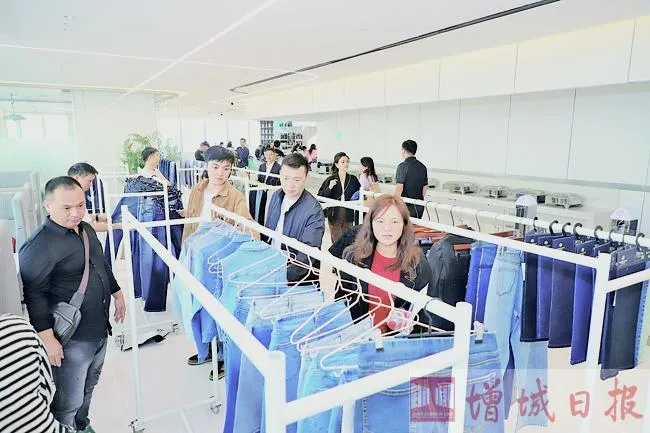
Guangzhou Chuangxing Garment Group Co., Ltd.
广州市创兴服装集团有限公司
Zengcheng District · Denim garment manufacturing and washing
Denim jeans
Guangzhou Xinbang Garment Industrial Co., Ltd.
广州市信邦服装实业有限公司
Zengcheng District · Denim garment manufacturing
Denim jeans
Guangzhou Guangjia Garment Co., Ltd.
广州广嘉服装有限公司
Zengcheng District · Denim garment manufacturing
Denim jeans
Guangzhou Sanhong Garment Manufacturing Co., Ltd.
广州市三宏制衣有限公司
Zengcheng District · Denim garment manufacturing
Denim jeans
VIGOSS (China) Guangying Garment Co., Ltd.
VIGOSS(中国)广英服装有限公司
Zengcheng District · Denim garment manufacturing and branded export
Denim jeans under the VIGOSS brand, exported to European and American high-end markets
Guangzhou Qiqi Textile and Garment Group Co., Ltd.
广州奇祺纺织服装集团有限公司
Zengcheng District · Denim garment manufacturing and export
Denim garments for overseas markets
Guangzhou Lianxin Garment Co., Ltd.
广州联欣服装有限公司
Zengcheng District · Denim garment manufacturing
Denim jeans
Guangzhou Zuochu Apparel Co., Ltd.
广州佐初服饰有限公司
Zengcheng District · Denim apparel design and manufacturing (integrated industry and trade)
Denim apparel (about 200 new styles per quarter)
Guangzhou Shengxinglong Garment Co., Ltd.
广州胜兴隆服装有限公司
Zengcheng District · Denim garment manufacturing
Denim jeans
Technical notes
- How denim jeans are made: cotton yarn is woven into twill fabric, dyed with indigo or sulfur dyes, then cut, sewn, and washed for finishing.
- Fabric weight matters: 10-12 oz is lightweight and breathable, 13-14 oz is the classic midweight, 15+ oz is heavy and durable but less flexible.
- Washing techniques: stone wash creates a vintage look, enzyme wash softens fabric, and acid wash gives a bleached effect; each affects durability differently.
Production capabilities
- Denim jeans factories typically handle fabric weaving, indigo dyeing, cutting, sewing, and finishing (washing, stone wash, enzyme wash).
- Common processes include pattern making, sample development, bulk cutting, assembly, and quality control. Some factories also handle fabric sourcing.
- Specialized equipment includes automatic cutting machines, chain stitch sewing machines, and washing machines for stone wash and enzyme wash.
Customization options
- OEM: Factory produces based on your fabric spec, pattern, and size chart. MOQ is typically 500+ pieces.
- ODM: Factory provides in-house designs or modifies existing styles. MOQ is typically 300+ pieces.
- Custom development: Full design from scratch, including fabric weaving, dyeing, and construction. MOQ is 1,000+ pieces and lead time is 60-90 days.
Common specifications
- Fabric weight: 10-12 oz (lightweight), 13-14 oz (midweight classic), 15+ oz (heavy duty). Weight affects durability, flexibility, and price.
- Yarn count: 7s-10s (coarse, durable), 11s-14s (fine, soft). Lower count is stronger but rougher.
- Finishing: Raw (unwashed), stone wash (vintage look), enzyme wash (soft), acid wash (bleached). Each affects fabric hand feel and durability.
Industry standards
- OEKO-TEX Standard 100: Chemical safety for fabrics and garments.
- BSCI / SEDEX: Social compliance audits for labor standards.
- ISO 9001: Quality management system certification.
Logistics & shipping
- Common shipping: FCL (Full Container Load) for 500+ cartons, LCL (Less Container Load) for smaller orders.
- Packaging: Each pair is polybagged, then cartoned (50-100 pairs per carton). Carton size is typically 60x40x40 cm.
- Transit time: 25-35 days by sea from Guangzhou to US/EU ports, 5-10 days by air.
Payment terms
- Standard terms: 30% T/T deposit, 70% T/T balance before shipment.
- Alternative: Letter of Credit (L/C) at sight for large orders (500+ cartons).
- Sample payment: 100% upfront, refunded or credited against bulk order.
Quality benchmarks
- Check stitching: Minimum 10 stitches per inch for strength. Look for double stitching on stress points (pockets, belt loops).
- Check fabric: No holes, consistent color, no excessive stretching. Fabric weight should match spec.
- Check hardware: Zippers should be YKK or equivalent, buttons should be solid metal, no rust or plating flaws.
Buyer's checklist
- Confirm MOQ, lead time, and payment terms before placing order.
- Request fabric sample (swatch) and finished garment sample for quality verification.
- Provide clear size chart, fabric spec, and washing instructions.
Frequently asked questions
Category-level guidance only. Confirm specific MOQ, lead time, and certification with each factory before ordering.
What is the typical MOQ for denim jeans?
Most factories work with 300-500 pieces per color and size. Some may accept 200 pieces for existing fabrics, while custom denim development usually requires 1,000+ pieces to cover dye and weaving costs.
Do you offer OEM/ODM services?
Yes. Most denim factories handle OEM production based on your fabric specification, and some offer full ODM from design to finished garment. Minimum order quantity is typically higher for custom designs.
What certifications should I check?
Look for BSCI, SEDEX or WRAP social audits for labor standards, and OEKO-TEX Standard 100 for fabric chemical safety. Confirm the factory holds valid audit certificates before placing orders.
What is the lead time?
Standard production takes 25-45 days depending on fabric availability and finishing complexity. Custom fabric development adds 2-3 weeks. Bulk orders may require 60+ days during peak seasons.
Browse
- Browse all marketsGuangzhou markets
- Browse all suppliersFactory list
- Denim fabricProducts
- Bags and leather goodsProducts
- HandbagsProducts
- Luggage and suitcasesProducts
- BackpacksProducts
Product categories are maintained by us as a taxonomy; they are not a claim about any factory's certification or capacity.